
Radial Lift vs. Vertical Lift Skid Steer: Which One Should You Choose?
2025-11-14
When it comes to choosing the right skid steer for your construction, landscaping, or material handling needs, one of the most important decisions is selecting between a radial lift skid steer and a vertical lift skid steer. Both types offer unique advantages, but understanding their differences is crucial to optimize efficiency and performance on your job site. At RQ Machines, we specialize in providing high-quality skid steers to help you make the best choice for your operations.
Understanding the Basics: Radial Lift vs. Vertical Lift
Before diving into the applications and benefits, let’s first define what each lift type means:
-
Radial Lift Skid Steer:
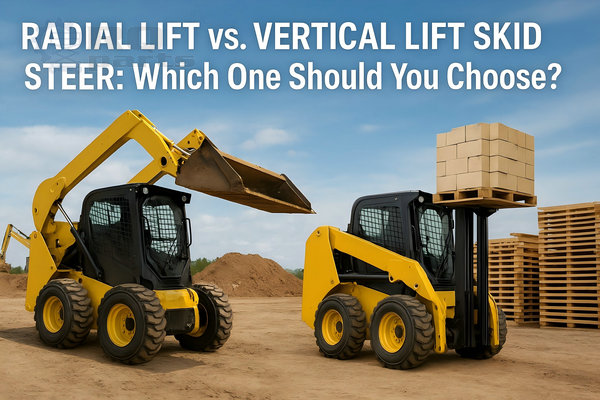
A radial lift skid steer operates with an arm that pivots in an arc, creating a rounded, radial path as it lifts the load. This design offers maximum stability at mid-height loads and excels in digging and grading tasks. -
Vertical Lift Skid Steer:
A vertical lift skid steer uses a parallel linkage system, allowing the arms to lift straight up and down. This provides greater reach at full height and better load-carrying capacity at higher lift points, making it ideal for stacking pallets or placing materials into trucks or hoppers.
Key Differences Between Radial Lift and Vertical Lift
1. Lifting Height and Reach
-
Radial Lift: Best for tasks that require mid-range lifting, such as digging, loading small trucks, or grading. The maximum reach at full height is limited due to the arc motion.
-
Vertical Lift: Offers extended reach at full height, allowing operators to place materials on high shelves, trucks, or hoppers efficiently.
2. Load Stability
-
Radial Lift: Provides better stability at mid-height because the load stays closer to the machine’s center of gravity.
-
Vertical Lift: Excellent for lifting heavy loads to full height, but the load moves farther from the center of gravity as the lift reaches maximum height, requiring careful operation.
3. Digging and Grading Performance
-
Radial Lift: Superior for digging and ground-level tasks due to its arc-shaped lift path, which naturally mimics a backhoe-style motion.
-
Vertical Lift: Less efficient for digging because the straight-up lift path doesn’t provide as much forward reach at lower heights.
4. Versatility
-
Radial Lift: Perfect for general construction, landscaping, and utility tasks.
-
Vertical Lift: Ideal for warehousing, industrial applications, or construction sites requiring high-reach loading and stacking.
Which Skid Steer is Right for You?
The choice depends largely on your work requirements:
-
Choose Radial Lift if:
-
You primarily need a skid steer for digging, grading, or mid-height loading.
-
You want a machine that is stable with medium loads.
-
Your site has uneven terrain or requires precise ground-level work.
-
-
Choose Vertical Lift if:
-
You need to lift materials to high places such as trucks, pallets, or hoppers.
-
You handle heavy loads regularly at full lift height.
-
Efficiency in stacking and reaching is a top priority.
-
RQ Machines: Helping You Make the Right Choice
At RQ Machines, we understand that choosing the right skid steer can significantly impact productivity and safety. Our experts can guide you in selecting between radial lift and vertical lift skid steers, considering factors such as job site conditions, load requirements, and budget.
Contact us today to learn more about our skid steer models, request a quote, or schedule a demo. Our team is committed to helping you get the right machine for your business needs.
FAQ
Q1: Can I switch between radial and vertical lift attachments?
A: No, the lift type is integral to the machine’s design. Choosing the right skid steer from the start is essential.
Q2: Are vertical lift skid steers more expensive?
A: Typically, yes. Vertical lift models may have higher upfront costs, but they offer efficiency advantages for high-reach tasks.
Q3: Which lift type is safer for rough terrain?
A: Radial lift skid steers provide better stability on uneven ground, reducing the risk of tipping during mid-height operations.