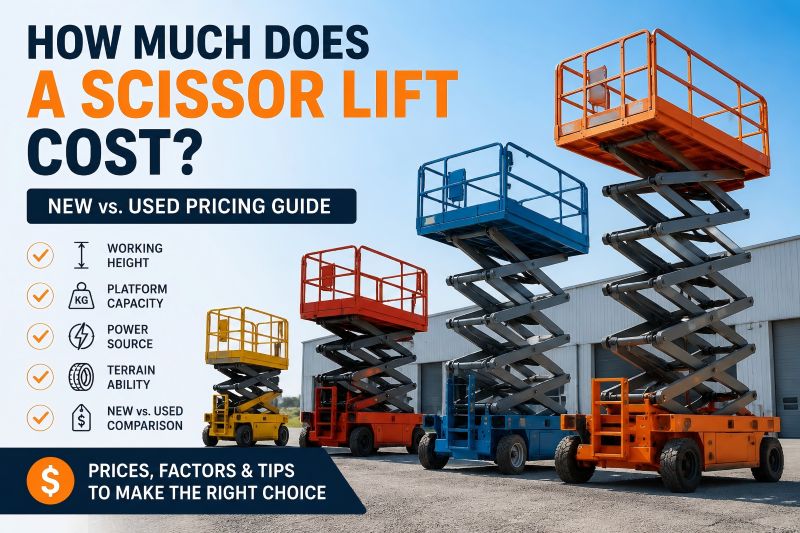
How Much Does a Scissor Lift Cost? New vs. Used Pricing Guide
2026-08-20
If you are planning to buy a scissor lift, one of the first questions is usually: How much does a scissor lift cost?
The answer depends on several factors, including working height, platform capacity, power source, terrain capability, brand, model, condition, age, operating hours, and shipping destination.
In general, a compact electric scissor lift is typically less expensive than a large rough-terrain model. Used scissor lifts can reduce the initial purchase cost, but the machine’s operating hours, maintenance history, battery or engine condition, and required repairs should be considered before comparing prices.
This guide explains what affects scissor lift prices, how to compare new and used machines, and what information you should provide to a supplier to get an accurate quotation.
Quick Answer: How Much Does a Scissor Lift Cost?
There is no single price for every scissor lift.
The main factors affecting the purchase price are:
| Factor | How It Affects Cost |
|---|---|
| Working height | Higher-reach machines generally cost more |
| Platform capacity | Higher-capacity machines can increase cost |
| Power source | Electric and diesel models have different price structures |
| Terrain | Rough-terrain and 4WD configurations generally cost more |
| Brand | Brand, model, availability, and support affect pricing |
| Condition | New machines usually cost more than used equipment |
| Operating hours | Lower-hour used machines generally have higher resale value |
| Age | Newer used machines generally command higher prices |
| Platform size | Larger platforms may increase equipment cost |
| Destination | International freight, duties, and local charges affect landed cost |
For this reason, a supplier should quote a scissor lift based on the specific model and configuration, rather than providing a generic price.
What Determines the Price of a Scissor Lift?
1. Working Height
Working height is one of the most important pricing factors.
A compact scissor lift designed for lower-level maintenance is generally less expensive than a high-reach model designed for major construction or industrial applications.
Before requesting a quotation, determine:
- Required working height
- Required platform height
- Building or ceiling height
- Required safety clearance
- Indoor or outdoor application
If you only tell a supplier that you need a “high scissor lift,” the supplier may not know which models are suitable.
For available machines, visit the Scissor Lift Equipment section.
2. Electric vs. Diesel
Power source can significantly affect the equipment configuration and purchase price.
Electric Scissor Lifts
Electric models are commonly used for:
- Warehouses
- Factories
- Shopping centers
- Indoor construction
- Facility maintenance
- Electrical installation
- Painting and finishing
They are particularly useful when low emissions and reduced noise are important.
Diesel Rough-Terrain Scissor Lifts
Diesel rough-terrain models are designed for more demanding outdoor environments, including:
- Construction sites
- Infrastructure projects
- Uneven ground
- Outdoor installation
- Rough terrain
These machines may include four-wheel drive, larger tires, greater ground clearance, and other features designed for outdoor mobility.
The cheapest machine is not necessarily the lowest-cost solution if it cannot perform effectively in your working environment.
New vs. Used Scissor Lift Prices
One of the biggest purchasing decisions is whether to buy a new or used machine.
New Scissor Lift
A new machine can be a better choice when you need:
- Long-term operation
- Predictable maintenance
- A specific configuration
- Lower initial repair risk
- Manufacturer support
- Warranty coverage
New equipment is generally more expensive upfront, but the total ownership cost may be more predictable.
Used Scissor Lift
Used equipment can be attractive for buyers who want to reduce the initial investment.
However, price alone should never determine whether a used scissor lift is a good purchase.
Check:
- Manufacturing year
- Operating hours
- Maintenance history
- Battery condition
- Engine condition
- Hydraulic system
- Tires
- Platform controls
- Emergency systems
- Structural condition
- Previous operating environment
A very low-priced machine may require significant maintenance after delivery.
For this reason, compare purchase price + expected repair and maintenance costs, rather than comparing purchase prices alone.
You can also explore used aerial lift equipment from RQ Machines.
How Much Does a Used Scissor Lift Cost?
Used scissor lift prices vary considerably because machines can differ significantly in age, working height, brand, operating hours, condition, and configuration.
For example, two machines with the same rated working height may have very different prices if:
- One has significantly fewer operating hours
- One has a newer battery
- One has complete maintenance records
- One has recently undergone inspection
- One requires hydraulic repairs
- One has worn tires
- One is from a more in-demand brand
Therefore, comparing used equipment by model name alone can produce misleading results.
When requesting a used scissor lift quotation, ask the supplier for:
- Manufacturing year
- Operating hours
- Machine condition
- Maintenance history
- Recent inspection information
- Current photos and videos
- Specification sheet
- Available accessories
- Spare parts availability
- Shipping options
Does Brand Affect Scissor Lift Price?
Yes.
Brands such as Genie, JLG, DINGLI, Haulotte, ZOOMLION, LGMG, and XCMG can have different market prices depending on model, age, condition, availability, and destination.
However, a higher-priced brand is not automatically the best option for every application.
Instead, compare the actual machine specifications.
Compare These Specifications
When comparing two scissor lifts, check:
| Specification | Why It Matters |
|---|---|
| Working height | Determines whether the machine can reach the work area |
| Platform height | Defines maximum platform elevation |
| Platform capacity | Determines worker and material load |
| Platform size | Affects working space |
| Machine width | Determines site accessibility |
| Machine weight | Affects transportation |
| Power source | Determines suitable applications |
| Drive system | Affects mobility |
| Gradeability | Important for outdoor sites |
| Ground clearance | Important for rough terrain |
| Operating hours | Important for used equipment |
RQ Machines supplies aerial work platforms from multiple manufacturers, allowing buyers to compare equipment according to their project requirements.
For example, you can explore new Genie equipment and new DINGLI equipment.
What Is the Total Cost of Buying a Scissor Lift?
The equipment purchase price is only part of the total cost.
For international buyers, consider the landed cost:
Total Landed Cost = Equipment Price + Freight + Insurance + Import Duties + Local Charges + Required Maintenance
Depending on the destination, buyers may also need to consider:
- Port charges
- Customs clearance
- Inland transportation
- Taxes
- Certification
- Local registration
- Initial maintenance
- Replacement parts
This is why asking for the machine price alone may not give you the actual cost of getting the equipment to your jobsite.
When requesting a quotation from an international supplier, provide your destination country and city or port.
The supplier can then provide more relevant shipping information.
How Can I Get a More Accurate Scissor Lift Quote?
The fastest way to get a useful quotation is to provide specific requirements.
Instead of:
“Please send me the price of a scissor lift.”
Send information such as:
We are looking for 2 scissor lifts for an outdoor construction project. Required working height is approximately 14 m, platform capacity should be at least 300 kg, and the machines should be suitable for uneven terrain. Destination: [country/port]. Please provide available models, specifications, photos, price, and shipping cost.
This allows the supplier to recommend suitable equipment instead of sending an unrelated equipment list.
Information to Include in Your Inquiry
- Quantity
- Working height
- Platform capacity
- Indoor or outdoor use
- Terrain
- Electric or diesel preference
- New or used
- Preferred brand
- Destination country
- Destination port
- Required delivery date
The more specific your requirements are, the easier it is to compare quotations from different suppliers.
What About Scissor Lift Spare Parts?
Purchase price is only one part of equipment ownership.
Long-term maintenance and spare parts availability can have a major impact on operating costs.
Common aerial lift replacement components include:
- Hydraulic components
- Electrical components
- Control boards
- Joysticks
- Sensors
- Switches
- Filters
- Drive components
- Engine components
- Cables and connectors
If you are buying used equipment, check whether the supplier can provide replacement parts for the machine after delivery.
RQ Machines also supplies aerial lift spare parts for various equipment brands.
This can be particularly important for international buyers because long equipment downtime can cost more than the original replacement part.
New or Used Scissor Lift: Which One Should You Buy?
There is no universal answer.
Choose a new scissor lift when reliability, long-term operation, warranty, and predictable maintenance are high priorities.
Choose a used scissor lift when reducing the initial purchase cost is more important and you have access to reliable equipment inspection and maintenance support.
A simple decision framework is:
| Your Priority | Consider |
|---|---|
| Long-term ownership | New |
| Lowest initial investment | Used |
| Frequent daily operation | New or low-hour used |
| Short-term project | Used may be suitable |
| Specific configuration | New or carefully selected used |
| Limited maintenance capability | Newer equipment |
| Experienced maintenance team | Wider used-equipment options |
7 Questions to Ask Before Buying a Scissor Lift
Before placing an order, ask the supplier:
1. What is the exact model?
The model number allows you to verify the machine’s specifications and compatibility.
2. What is the actual working height?
Do not rely only on general descriptions such as “high reach.”
3. What is the rated platform capacity?
Confirm the capacity according to the manufacturer’s specifications.
4. Is the machine suitable for indoor or outdoor operation?
Application requirements can differ significantly.
5. What is the machine’s operating hour?
This is particularly important for used equipment.
6. Are spare parts available?
Ask about replacement parts and long-term maintenance support.
7. What is the shipping cost to my destination?
For international purchases, equipment price and landed cost are not the same.
Frequently Asked Questions
How much does a scissor lift cost?
Scissor lift prices vary by working height, platform capacity, power source, terrain capability, brand, condition, operating hours, and destination. A specific model and configuration are needed for an accurate quotation.
Are used scissor lifts cheaper than new ones?
Generally, used machines have a lower initial purchase price than comparable new machines. However, buyers should also consider maintenance, repairs, operating hours, and remaining service life.
Is an electric scissor lift cheaper than a diesel model?
It depends on the model and configuration. Electric and diesel scissor lifts are designed for different applications, so price should be compared together with working environment, performance, and operating requirements.
What is the cheapest type of scissor lift?
Compact models with lower working heights and simpler configurations generally have lower purchase prices. However, the cheapest machine is not necessarily the most economical if it does not meet the requirements of the jobsite.
What should I check when buying a used scissor lift?
Check the manufacturing year, operating hours, maintenance records, battery or engine condition, hydraulic system, tires, controls, emergency systems, structural condition, and inspection history.
Does RQ Machines sell used scissor lifts?
Yes. RQ Machines supplies new and used aerial work platforms and can provide equipment information, specifications, photos, and quotation options based on project requirements.
Can I buy scissor lift spare parts from RQ Machines?
Yes. RQ Machines supplies aerial lift parts for multiple equipment brands. Buyers should provide the machine brand, model, and preferably the original part number when requesting a replacement component.
Conclusion
The price of a scissor lift depends on much more than the machine itself.
Working height, platform capacity, power source, terrain capability, brand, machine condition, operating hours, transportation, and spare parts availability can all affect the total cost of ownership.
If you are comparing new vs. used scissor lifts, the best approach is to compare the complete equipment specification and expected operating cost rather than choosing the lowest initial price.
If you know your required working height, platform capacity, application, quantity, and destination, send these details to RQ Machines. The supplier can then recommend suitable scissor lift models and provide a more accurate equipment and shipping quotation.
Looking for a scissor lift for sale? Contact RQ Machines with your requirements to compare available models, specifications, prices, and delivery options.